.gif)



Digital Advertising
-
August 27, 2026
How Much Do Social Media Ads Really Cost in 2025?
written by

Social media advertising cost in 2025 typically starts around $1,500–$2,500/month for meaningful testing, with larger/complex campaigns scaling higher. Pricing is usually CPC (pay per click) or CPM (pay per 1,000 impressions).
Benchmarks: US CPM ~$6–$30+, AU CPM ~$10–$40 (platform + seasonality dependent).
What moves the cost: platform (Meta/TikTok/LinkedIn/YouTube), objective (awareness vs conversion), audience breadth, creative quality, competition/seasonality.
Social media advertising cost in 2025 typically ranges between $1,500 and $2,500 per month for small to mid-sized brands, with larger campaigns often exceeding $10,000+ depending on goals and platforms.
Advertisers usually pay either per click (CPC) or per 1,000 impressions (CPM).
Average CPMs range from $6–$30+ USD in the US and $10–$40 AUD in Australia, influenced by platform and targeting.
Key factors that affect cost include:
- Platform: Meta (Facebook & Instagram), TikTok, LinkedIn, YouTube
- Objective: Awareness vs. conversions
- Audience: Size, competitiveness, and location
- Creative quality: Visual impact, engagement rate, and ad relevance
- Seasonality & bidding: Prices rise during high-demand periods (e.g., holidays, sales events)
In short, the true cost depends less on how much you spend and more on how strategically you spend it.
If you’re looking for a broader foundation before diving into costs, our complete guide to social media advertising breaks down platforms, formats, targeting, and best practices in detail.
What Impacts the Cost of Social Media Ads?
Not all ads are priced equally. The amount you pay depends on a combination of factors. Some you control, others you don’t. Think of it like booking a flight: the destination matters, but so do the time of year, airline, and how early you book.

Here’s what affects your ad costs:
1. The Platform
Facebook, Instagram, TikTok, LinkedIn, and others each have their pricing quirks.
- Meta (Facebook & Instagram) offers broad reach, solid targeting, and mid-range costs.
- TikTok can be cost-effective, but it demands scroll-stopping creative content.
- LinkedIn is pricey, but often worth it for B2B leads.
- YouTube sits somewhere in the middle, ideal for brand storytelling.
2. Campaign Objective
A traffic campaign costs less than a conversion campaign. The more you ask of a user, the more you will likely pay.
3. Audience Targeting
A broad audience generally yields a cheaper audience. The more requirements you add to limit your target audience, the more expensive the ads will be.
4. Ad Format
Video ads typically outperform static images, but they often come at a higher production cost.
Carousels, stories, and reels all have different engagement rates and cost implications.
5. Competition & Bidding
You’re not the only one trying to reach your audience. During peak times (Black Friday, end-of-financial-year), ad space gets more competitive and prices spike. Platforms run on auctions, and you’re bidding against others for attention.
Ad platforms run auctions, so pricing shifts with demand, competition, and your goals. See Meta’s overview of ad metrics and CPM and Google’s YouTube ad metrics guide for the basics.
Ultimately, ad costs are shaped by the decisions you make upfront. A clear social media advertising strategy helps align objectives, targeting, creative, and budget so every dollar works harder from day one.
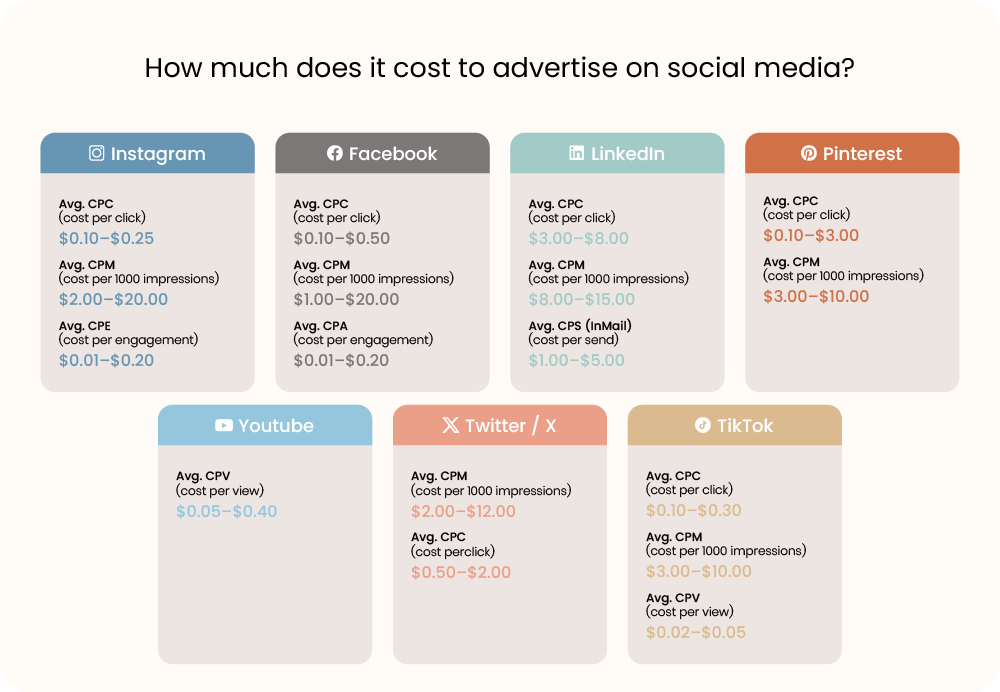
Cost Benchmarks by Platform and Region
Let’s get to the numbers. These averages are not fixed, but they give a reliable benchmark when estimating spend.
Cost of Social Media Adverts in Australia:
Cost of Social Media Adverts in USA:
Pro Tip: These numbers shift with competition, seasonality, and how dialled-in your targeting and creative are. Great ads can lower your CPM. Average ones won’t.

What Is a Good Budget for Social Media Advertising?
There is no one-size-fits-all budget for social media ads. The right starting point depends on your objective, platform, and the extent of testing you are prepared to conduct.
According to Nutshell’s 2025 Social Media Advertising Report, Most small to mid-sized businesses see traction starting with $1,500 to $2,500 per month, especially on Meta platforms like Facebook and Instagram. This range enables you to conduct meaningful tests, gather valuable insights, and make informed decisions.
- If your goal is lead generation, your budget may stretch further since the cost per result is generally lower.
- If you are running conversion campaigns, such as driving purchases, expect to need a higher starting budget or allow more time for the platform to optimise. These campaigns ask more of the algorithm and typically require more data to succeed.
At this point, many businesses ask the same question: is paid social actually worth the investment? If you’re still weighing it up, we break it down clearly in is social media advertising worth it, including when paid social makes sense and when it doesn’t.
Plan for 3 to 6 Months of Testing
Good optimisation takes time. Each week of ad spend might only deliver a handful of meaningful data points. Most campaigns require several testing cycles over three to six months to identify what consistently performs well. Your early budget is an investment in learning what works, not just in buying clicks.
Let Profit Guide Your Ad Spend
In the early stages, you might need to invest without seeing immediate returns. This phase is about building awareness, testing creativity, and learning what resonates. But once your ads start performing, your budget should be shaped by one key question. Can you continue to spend more while still making a profit? It is not about how much you spend, it is about spending in a way that consistently brings in more than it costs.
Spend Smarter with These Guidelines:
- Start with one platform and maximise its potential before expanding.
- Match your budget to the campaign goal. Awareness campaigns can start smaller($500-$1,000). Conversion campaigns require more data and creative testing ($1,500 - $2,500 to start).
- Know your numbers and turn off ads that do not meet your KPIs. Define your ideal cost per lead or sale and use it to guide decisions and cut what underperforms.
- Adapt your budget to seasonal trends. Spend more when demand and conversions are high. Pull back when seasonality or rising costs make returns harder to achieve.
Success comes from structured testing, clear metrics, and patience. With the right strategy, your media budget becomes an investment, not a gamble.
Should you work with an agency?
Not every business needs an agency from day one. If you are still validating your product or offer, it is often better to start small and get your hands dirty. Running ads yourself can help you understand your audience, test your positioning, and build a feedback loop without burning through your budget too quickly.
A good agency can help you lay the proper foundation and give you the best chance of testing an idea properly. However, no marketing strategy can compensate for a product that lacks market fit. If your offer is unproven, it is often better to invest in learning and testing the fundamentals yourself before committing a large portion of your budget to agency support unless you’ve budgeted for it.
What an agency offers is a team of specialists with experience across many industries. You are not just paying for services. You gain access to a team of experts across strategy, media buying, creative, analytics, and optimisation, all working together to help you grow. Here’s what a full-service agency should be able to offer.
- Strategic planning and performance forecasting
- Rapid testing cycles across multiple creative angles and audiences
- Scroll-stopping ad creatives tailored to your brand, platform, and customer journey
- Full-funnel strategy and funnel building to align every stage from awareness to sale
- Conversion tracking and pixel setup so you can measure what matters
- Ongoing creative refreshes to reduce fatigue and improve results over time
- Campaign optimisation and audience scaling for sustainable growth
- Clear performance reporting and insights to guide your next move
- Holistic support across paid media, email, landing pages, and organic content
Once you start to see signs of traction, a good agency can help you scale more quickly and efficiently. It is one of the quickest ways to access the talent you need to take your business to the next level.
Not sure whether you are ready for an agency? Start a conversation with us, and we'll help you determine the best next step.
Estimate the Impact of Your Spend
Knowing how much to spend is only part of the picture. What matters is understanding what kind of results the ad spend can realistically deliver.
Most ad platforms provide basic forecasting tools. They are helpful as a starting point, but without the proper context, they can create misleading expectations.
To understand what that spend actually delivers, our guide on how to measure social media advertising ROI explains the metrics that matter, how to calculate returns, and how to connect ad spend to real business outcomes.
Use Platform Forecasts as a Starting Point
Meta Ads Manager and Google Ads Planner can show you estimated reach, impressions, or clicks based on your budget. While helpful for ballpark figures, these tools do not account for factors like creative strength, audience quality, or funnel performance.
Set Expectations Based on Strategy, Not Hope
If your goal is to generate leads, bookings, or purchases, base your expectations on your business data. What is your average order value or lead conversion rate? How many clicks do you need to make a sale? These numbers matter more than what the platform suggests.
This Is Where Experience Helps
At Born Social, we bring insight from hundreds of campaigns across Hospitality, Fashion & Retail, Beauty & Wellness, and Consumer Goods. We understand what performance looks like in your industry and can help you avoid common mistakes.
We can help you:
- Identify growth opportunities based on your goals and offer
- Identify early warning signs before your budget is wasted
- Align your media spend with your actual business goals
When you combine real data with real-world experience, your ad spend becomes a smart investment instead of a guessing game.
Conclusion
Frankly, social media ads are becoming more and more competitive. However, success is not solely about how much one is spending. It’s about how well you spend it.
The business who wins at the end of the day are the ones that constantly plan, test, and refine. They do not take shortcuts by boosting and hoping for the best. They build real strategies, learn from the data, and then make informed choices.
If you’re unsure of where to begin, you are definitely not alone! We’ve witnessed many businesses burn through their budget before realising they need a better approach or the support of a knowledgeable team that has executed it all before.
Here at Born Social, we’d like to quit playing the guessing game with social media advertising. Whether or not you’re just starting with $1,500 or scaling past $10k, we’ll help you spend smarter because we believe in quality over quantity.
Book a free strategy call with our team or learn more about our Digital Advertising Services!
Frequently Asked Questions
What is a reasonable budget for social media advertising in 2025?
Most small to medium-sized businesses can start seeing meaningful traction with a monthly budget between $1,500 and $2,500 on platforms like Facebook and Instagram. If you are testing across multiple platforms or operating in a competitive niche, such as finance or technology, you may need to invest $3,000 to $5,000 per month.
It is not about spending more. It is about spending with a clear objective and tracking performance along the way.
How much do Facebook ads cost per 1,000 views?
In the United States, CPM typically ranges from $10 to $15 USD. In Australia, the average falls between $14 and $22 AUD.
Your actual cost depends on how competitive your audience is and how effective your targeting and creative are.
How much do Instagram ads cost per 1,000 views?
Instagram CPMs are usually similar to Facebook, ranging from $10 to $20 USD or $14 to $22 AUD.
It often performs better for visual-first campaigns and lifestyle brands. Good creative makes a big difference here.
Why are LinkedIn ads more expensive?
LinkedIn targets high-value professionals and decision-makers, especially for B2B.
That audience is smaller and more specific, so the cost to reach them is higher. CPMs can reach $30 USD or $40 AUD, but the return can justify the investment when the offer and targeting are right.
Do I need an agency to run social media ads?
Not always. If your product is still in the early stage or you are testing market fit, it can be smart to run ads yourself first.
Once you have something working, a good agency brings you the creative, strategy, tracking, and testing systems needed to scale without wasting time or money.
Can I get results with a small ad budget?
Yes, but you need to be focused.With clear messaging, good targeting, and strong creative, even a $1,000 budget can drive leads or sales.Smaller budgets take longer to collect reliable data, so it is important to be patient and strategic.
References:
Meta — Optimize ad campaign / CPM & delivery basics: https://developers.meta.com/horizon/resources/optimize-ad-campaign/
Meta — Metrics benchmarks (context for performance ranges): https://developers.meta.com/horizon/resources/publish-metrics-benchmarks
LinkedIn — Advertising costs & pricing: https://business.linkedin.com/marketing-solutions/ads/pricing
TikTok — Bidding strategies + CPV change: https://ads.tiktok.com/help/article/bidding-strategies , https://ads.tiktok.com/help/article/changes-cpv-bidding-reporting
Google Ads Help — YouTube ad metrics + Formats + Masthead CPM: https://support.google.com/google-ads/answer/2375431 , https://support.google.com/google-ads/answer/2375464 , https://support.google.com/google-ads/answer/9709826
Google Ads Help — Product change (Video Action → Demand Gen): https://support.google.com/google-ads/answer/10147229
Hootsuite — Social media advertising guide + Benchmarks 2025: https://blog.hootsuite.com/social-media-advertising/ , https://blog.hootsuite.com/social-media-benchmarks/
WordStream — Facebook Ads Benchmarks 2025: https://www.wordstream.com/blog/facebook-ads-benchmarks-2025

about the author

Social Media Management Pricing in Australia (2026 Guide)

How to Choose a Social Media Agency in Melbourne
Have a



%201.png)
%202.png)
